
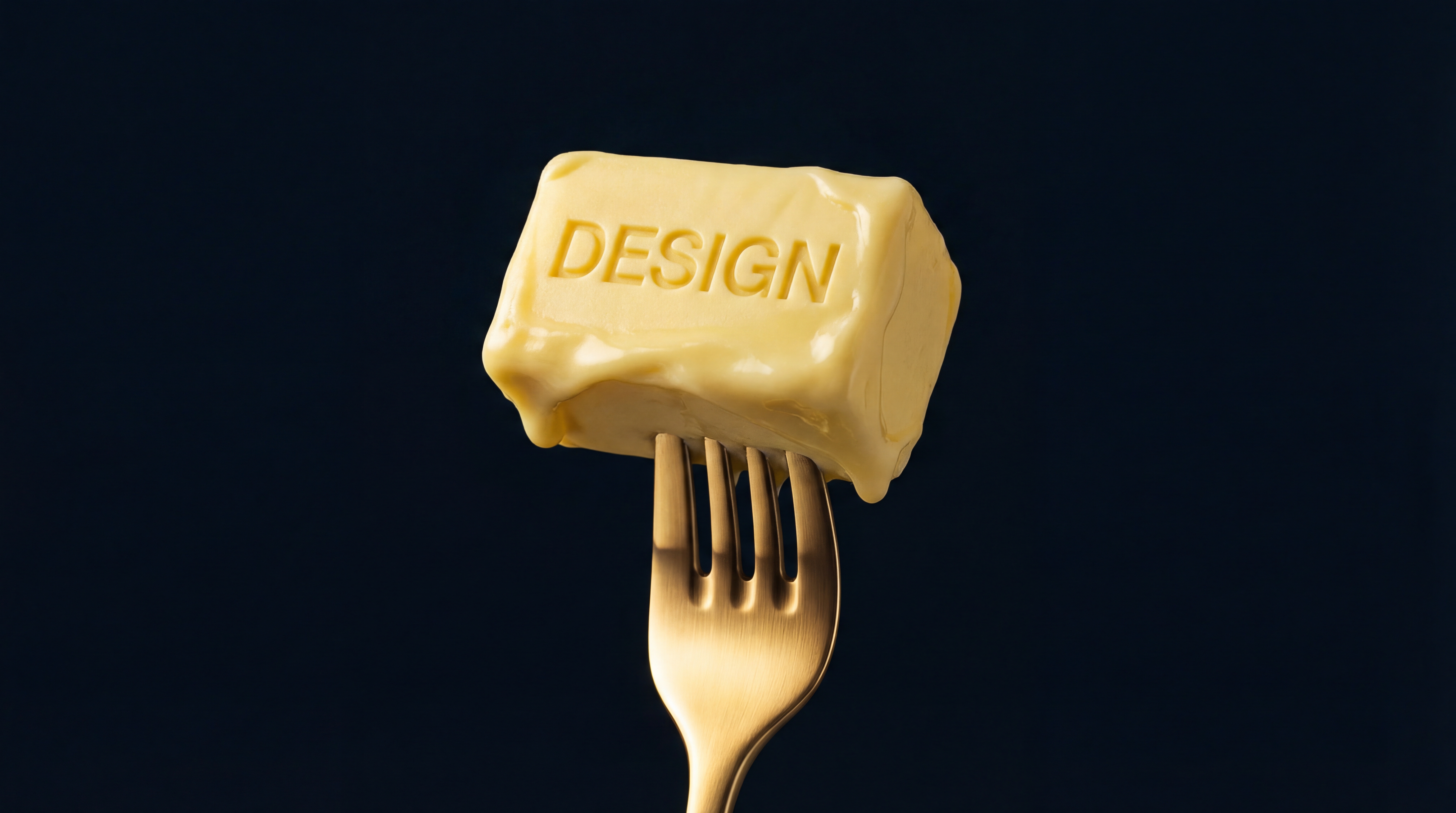
Today, people often encounter a brand visually before they encounter its meaning. Research on web-page perception has shown that users can form an opinion about a page’s visual appeal in a matter of milliseconds – in particular, work by Gitte Lindgaard and co-authors suggests that visual attractiveness can be assessed within about 50 ms.
At the same time, the cost of friction has risen: if the digital experience "lags", users have almost no motivation to tolerate it. Research indicates that 53% of visits are likely to be lost if a mobile page takes longer than 3 seconds to load.
Together, these two facts lead to a hard conclusion: it’s not enough to "style" something. You need a visual form that, quickly and with minimal effort:
explains what this is,
confirms it can be trusted,
nudges what to do next,
and does all of that under real conditions: screen/street/shelf, speed, noise, competitors, and the cost of getting it wrong.
That’s why La Miré does not "make design" in the usual sense. La Miré creates visual solutions: form as an instrument that solves a task and works toward metrics – the same way strategy, product, or marketing does.
What a visual solution Is – and how it differs from design
Professionally speaking, design does not have to be «vague» or "about beauty". In a classic formulation, design is described as the activity of transforming an existing situation into a preferred one – in other words, decision-making rather than "decoration".
But in everyday business practice, the word "design" often drifts toward outward form: color, type, composition, "wow-effect". That’s where a common trap appears: teams discuss how it looks, but don’t define what must change. This is the gap that visual solutions close.
A visual solution is design put on the rails of goal, context, and verification. It is not a "pretty picture", but a hypothesis about human behavior, expressed as a visual system and tied to criteria for success.
One of the clearest markers of the difference is the question the result answers:
"Design", in its everyday meaning, often answers: "Do we like it / not like it?"
A visual solution answers: "Did it work / didn’t it – and why?"
There’s one more thing that matters: design is communication. Design is often described as a dialogue (a conversation) between designer and user, where the "message" is delivered through form and interaction even when the author is not present.
If design is communication, then a visual solution is communication for which responsibility for the consequences is taken in advance.
The La Miré formula: four optics that turn visuals Into outcomes
For visuals to become a solution rather than an ornament, we view the task through four optics at once. These are not «industries» or "sciences" – they are four points of professional accountability that converge into one result:
La Miré Formula
Visual solution = Marketing × Psychology × Economics × Design
The «×» sign is not decorative: if even one multiplier equals zero, the result is zero too.
Marketing (meaning and addressee)
Marketing ensures the visual system doesn’t exist «in a vacuum» but inside positioning: who you are for, why you are chosen, what differentiates you, what next step you want from the audience.
Psychology (how a person reads it)
Psychology covers perception: what the brain grasps quickly; where doubt appears; what strengthens trust; what simplifies choice. The result is form that isn’t just aesthetics, but attention management and interpretation.
Economics (cost, effectiveness, trade-offs)
Economics enforces the core business condition: the solution must be feasible and justified. What is the budget? How does it scale? What is the cost of an error? What is cheaper: redesign now or lose conversion later? The economic optic forces you not to "pick a color", but to make a decision about producing an effect.
Design (form, system, implementation)
Design is execution: composition, typography, visual hierarchy, grids, identity, interface patterns, responsiveness, media, production constraints. It’s the craft that turns strategy into a tangible form – and form into a repeatable system.
Evidence: why visual solutions move metrics
When La Miré says "solutions", it isn’t a metaphor. Research and management-consulting practice both show that mature design and user-experience work correlates with financial performance.
A McKinsey study describes a relationship between high scores in design maturity and business results: companies in the top quartile of the index grew revenue and total returns to shareholders significantly faster than competitors – the report cites an estimate of +32 percentage points in revenue growth and +56 percentage points in TRS over a five-year period compared to industry peers.
Another angle is the long-term value of "design-led" organizations. In a McKinsey analysis for the consumer goods industry, a Design Management Institute study is referenced: between 2004 and 2014, design-led companies delivered returns 219% higher than the S&P 500 (the source discusses methodology separately).
It’s important to read this correctly: these studies describe correlations and comparable portfolios, not a "magic button". But they show a direction: design as a management function often intersects with growth.
So what happens "on the ground" – at the level of human perception?
One effect frequently referenced by UX researchers is the aesthetic-usability effect: people tend to perceive more attractive products as more usable (even if objectively they are not). In simpler terms: aesthetics can reduce resistance, increasing tolerance for minor flaws and strengthening a sense of quality.
This aligns with more fundamental perception psychology. The paper "Processing fluency and aesthetic pleasure: is beauty in the perceiver’s processing experience?" formulates the idea of processing fluency: the easier an object is for the brain to process, the more positive the aesthetic response can be.
In business terms, that looks like this: clear visual hierarchy and a "readable" system reduce the cognitive cost of choice – helping a person move faster from "I’m looking" to "I understand" to "I act".
Finally, speed is also a visual solution, because it shapes behavior. If half of mobile visits can be lost due to load times over 3 seconds, then "beauty" that makes a page heavier and breaks the scenario stops being an advantage.
How La Miré turns a request into a visual solution
If we had to describe the La Miré approach in one principle, it would be this: criteria first – form second. It sounds simple, but it is exactly what’s most often skipped when "design" is sold as a set of beautiful references.
Below is the logic of the process (without bureaucracy, but with decision discipline):
First, we lock the goal and the context. Not "I want it modern", but what task we are solving and where it has to work. This aligns with the logic of design thinking: IDEO (via Tim Brown’s formulation) describes design thinking as a human-centered approach that connects people’s needs, technological possibilities, and business requirements.
Next come the questions that turn a «picture» into a solution.
If it’s a website
What matters is not "colors" as taste, but performance parameters:
who the user is and what state they arrive in,
what they must understand in the first seconds,
what the success metric is (lead, purchase, booking, subscription, RFQ),
what trust barriers must be removed,
what constraints exist (speed, SEO, content, structure).
If it’s a poster or outdoor communication
Context matters more than aesthetics:
reading distance, movement speed, environmental noise,
who «looks»: age, motivation, social context,
one glance or multiple touchpoints,
where and how the target action happens (QR, website, checkout, call).
If it’s branding
The key isn’t "drawing a logo", but building a recognition-and-trust system that survives scaling. The study "Where Schön and Simon agree: The rationality of design" (Hans Georg Schaathun in partnership with Lucidpress) captures an applied takeaway: respondents estimated that with consistent brand presentation, average revenue growth could reach 23%, and it also noted that brands with consistent presentation are multiple times more likely to have excellent brand visibility.
Yes, this is respondents’ assessment, not a "guarantee". But as a managerial signal it’s clear: consistency is an economic factor, not a decorative one.
And one more point from mature practice: in its report on the business value of design, McKinsey notes that a meaningful share of companies do not speak with end users during development and do not have objective ways to evaluate and set goals for the results of design teams.
La Miré builds the process so form does not become a hostage to subjective taste – a solution must have quality criteria that are clear to both the client and the team.
Why work with La Miré
There is a simple test that distinguishes "design" from a "visual solution". Ask two questions:
First:
"Why this way?"
Second:
"How will we know it worked?"
If there are no clear, professionally grounded answers – you are buying «beautiful». If there are answers – you are building a growth instrument.
La Miré is a team that creates visual solutions at the intersection of marketing, economics, psychology, and design. We take responsibility not only for the form, but for the logic: goal → context → criteria → hypothesis → visual system → implementation → measurement.
If you want your next website, branding, communication, or visual system to be not a collection of references but a solution with clear cause-and-effect logic – La Miré is here for exactly that.